FoodSafety.gov
Cook to a Safe Minimum Internal Temperature ↗
https://www.foodsafety.gov/food-safety-charts/safe-minimum-internal-temperatures
Check your chicken internal temp reading and find where to measure.
Based on USDA & FoodSafety.gov guidance.See sources
For home cooking, USDA recommends 165°F (74°C) for all poultry.
Measure the internal temp of chicken in the thickest part.
This interactive checker needs JavaScript. The poultry minimum is 165°F (74°C). Read the measurement guide below.
Waiting for a reading
Your result will show here.
The checker compares your reading with 165°F (74°C). It doesn't estimate cooking time.
Temperature is only one part of safe food handling. Follow the latest guidance from USDA and FoodSafety.gov.
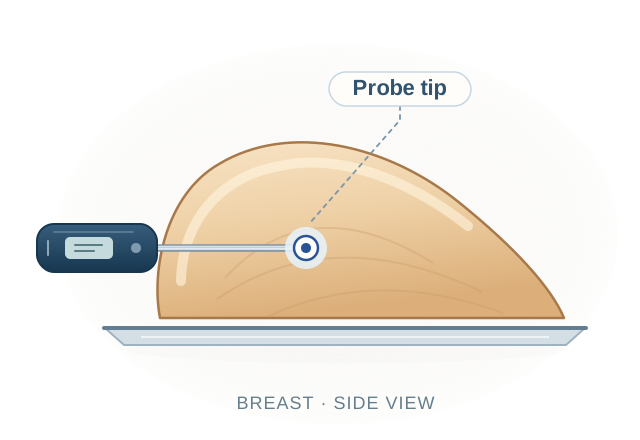
Every cut has the same USDA home-cooking minimum: 165°F (74°C). What changes from cut to cut is where the thermometer goes.
| Cut | USDA home-cooking minimum | Where to measure |
|---|---|---|
| Chicken breast | 165°F (74°C) | Thickest part. For thin or boneless breasts, go in from the side to the center. |
| Chicken thigh | 165°F (74°C) | Thickest part, without touching the bone. |
| Chicken drumstick | 165°F (74°C) | Thickest part, alongside the bone without touching it. |
| Chicken wing | 165°F (74°C) | Thickest meat, away from the thin bones. |
| Whole chicken | 165°F (74°C) | Thickest part of the breast, innermost part of the thigh, and innermost part of the wing. Avoid bone. |
| Ground chicken | 165°F (74°C) | Center of the thickest part. For patties, go in from the side. |
| Stuffing | 165°F (74°C) | Center of the stuffing. If it is inside a bird, check the bird too. |
The chicken breast temp to reach is 165°F (74°C) in the thickest part. For thin or boneless breasts, insert the thermometer from the side so the sensing area reaches the center. For bone-in breasts, keep it clear of the bone. Check individual pieces when their sizes differ.
Thermometer placement and common mistakes
The chicken thigh temp minimum is also 165°F (74°C). Measure the thickest meat without touching bone. For a whole bird, check the innermost thigh where it meets the body, as well as the breast and wing. Tenderness is a texture preference, separate from this minimum.
Put the tip in the thickest part of the meat. Bone and the pan can throw off the number, so keep the tip away from both.
Select a cut in the checker to see its measurement diagram.
Different parts of a whole bird reach temperature at different times, so one reading isn't enough. Check three spots and make sure each one reads at least 165°F (74°C).
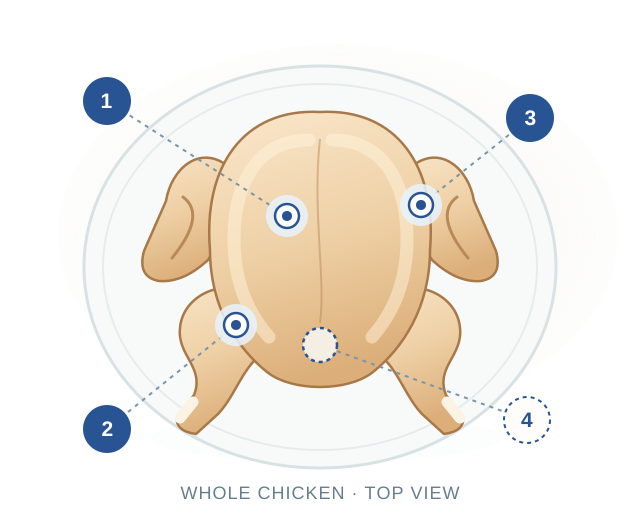
If any spot reads below 165°F (74°C)Keep cooking, then check that spot again. Enter each reading in the checker one at a time. The minimum is the same for every spot.
Color can't confirm the temperature. Chicken that has reached 165°F can still look pink, and chicken that looks white can still be under the minimum.
USDA's Food Safety and Inspection Service describes several reasons cooked poultry can stay pink:
The minimum doesn't change with the cooking method: 165°F (74°C) for the oven, the grill, the air fryer, and everything else. What changes is how to get a clean reading. This page doesn't give cooking times.
| Method | How to get a clean reading |
|---|---|
| Oven roasting or baking | Check the thickest piece and keep the tip off the pan. |
| Grilling | Check the thickest piece and keep the tip from touching the grate. |
| Air frying | Pull out the basket and check the thickest piece. If the basket was crowded, check more than one. |
| Pan-searing | Lift the piece or angle the probe so the tip stays in the meat, not against the pan. |
| Smoking | Smoke can leave a pink ring near the surface. Go by the reading in the thickest part. |
| Slow cooker | Check the largest piece. For shredded chicken, check a few spots in the pot. |
| Microwave | Microwaves heat unevenly, so check the temperature in several places. |
| Deep frying | Lift the piece out of the oil before you measure, so the probe reads only the meat. |
| Sous vide | Recipes for sous vide chicken breast often hold chicken below 165°F for a set time. This site doesn't calculate those times, and the checker uses 165°F (74°C). |
Not under USDA home-cooking guidance. The 145°F rule, with a 3-minute rest, covers whole cuts of beef, pork, veal, and lamb, such as steaks, chops, and roasts. For all poultry, USDA lists 165°F (74°C).
| Food | Minimum | Rest time |
|---|---|---|
| All poultry: whole, pieces, and ground | 165°F | None listed |
| Beef, pork, veal, and lamb steaks, chops, and roasts | 145°F | 3 minutes |
| Ground beef, pork, veal, and lamb | 160°F | None listed |
Source: FoodSafety.gov minimum-temperature chart.
Some recipes and food-science articles take chicken off the heat at 150°F to 160°F and rely on holding it at that temperature for a set time. That method depends on exact temperatures and times, and it isn't part of USDA's home-cooking chart.
This site doesn't calculate holding times. The checker reports any reading below 165°F (74°C) as below the minimum.
USDA’s home-cooking minimum for chicken is 165°F (74°C), measured with a food thermometer in the thickest part. For a whole chicken, check the thickest part of the breast and the innermost parts of the thigh and wing. Texture is a separate question. Thighs are often cooked longer because they turn more tender.
Not for safety. The chicken done temp is 165°F (74°C) for breasts, thighs, drumsticks, and wings. Some cooks take dark meat higher for texture, but that isn't a different minimum.
Those readings are below the USDA home-cooking minimum, and the checker shows them as Not there yet. Some recipes use lower pull temperatures with a holding time. This site doesn't calculate holding times, so keep cooking until the thickest part reads 165°F (74°C).
70°C is 158°F, which is below the minimum. In °C mode the checker compares your reading with 74°C, so 70°C shows as below the minimum.
165°F works out to 73.89°C. FSIS lists it as 73.9°C and FoodSafety.gov lists it as 74°C. The checker uses 74°C for Celsius readings, the cautious side of that rounding, so a reading of 73.9°C shows as below the minimum. Readings are never converted between units. Switching from °F to °C clears the reading, so rounding can't turn a reading below the minimum into one that meets it.
The USDA minimum-temperature chart lists a three-minute rest for whole cuts of beef, pork, veal, and lamb at 145°F. It does not list a general poultry rest time. Follow method-specific standing instructions, especially when microwaving. A rest does not replace measuring 165°F (74°C).
Not reliably. Color, clear juices, firmness, and cooking time can't show the internal temperature. Use a food thermometer in the thickest part.
Follow the thermometer maker’s calibration instructions. For an ice-water check, fill a glass with ice, add drinking water, and stir. Immerse the stem at least 2 inches without touching the glass. Wait at least 30 seconds. The expected reading is 32°F (0°C); follow the maker’s adjustment or replacement instructions if it differs.
No. It doesn't use weight, oven temperature, cooking time, or photos, and it doesn't predict minutes. It only compares the reading you enter with 165°F (74°C).
No. Chicken Temp Guide is an independent site. It summarizes public U.S. food-safety guidance from FoodSafety.gov and USDA's Food Safety and Inspection Service, and it links to those pages.
Official USDA FSIS and FoodSafety.gov references for temperature minimums and measurement instructions.
FoodSafety.gov
https://www.foodsafety.gov/food-safety-charts/safe-minimum-internal-temperatures
USDA FSIS
https://www.fsis.usda.gov/food-safety/safe-food-handling-and-preparation/food-safety-basics/safe-temperature-chart
USDA FSIS
https://www.fsis.usda.gov/food-safety/safe-food-handling-and-preparation/food-safety-basics/food-thermometers
USDA FSIS
https://www.fsis.usda.gov/food-safety/safe-food-handling-and-preparation/poultry/chicken-farm-table